Corporate Tax in Canada: The Owner-Manager Guide (2026)
The Canadian corporate tax system has two main rates for incorporated businesses, a multi-decade carve-out for small businesses that drops the rate sharply, an annual claw-back tied to passive investment income, a four-pool tracking system for distributable surplus, and an integration concept that — when it works — makes incorporation roughly tax-neutral compared to earning the same income personally.
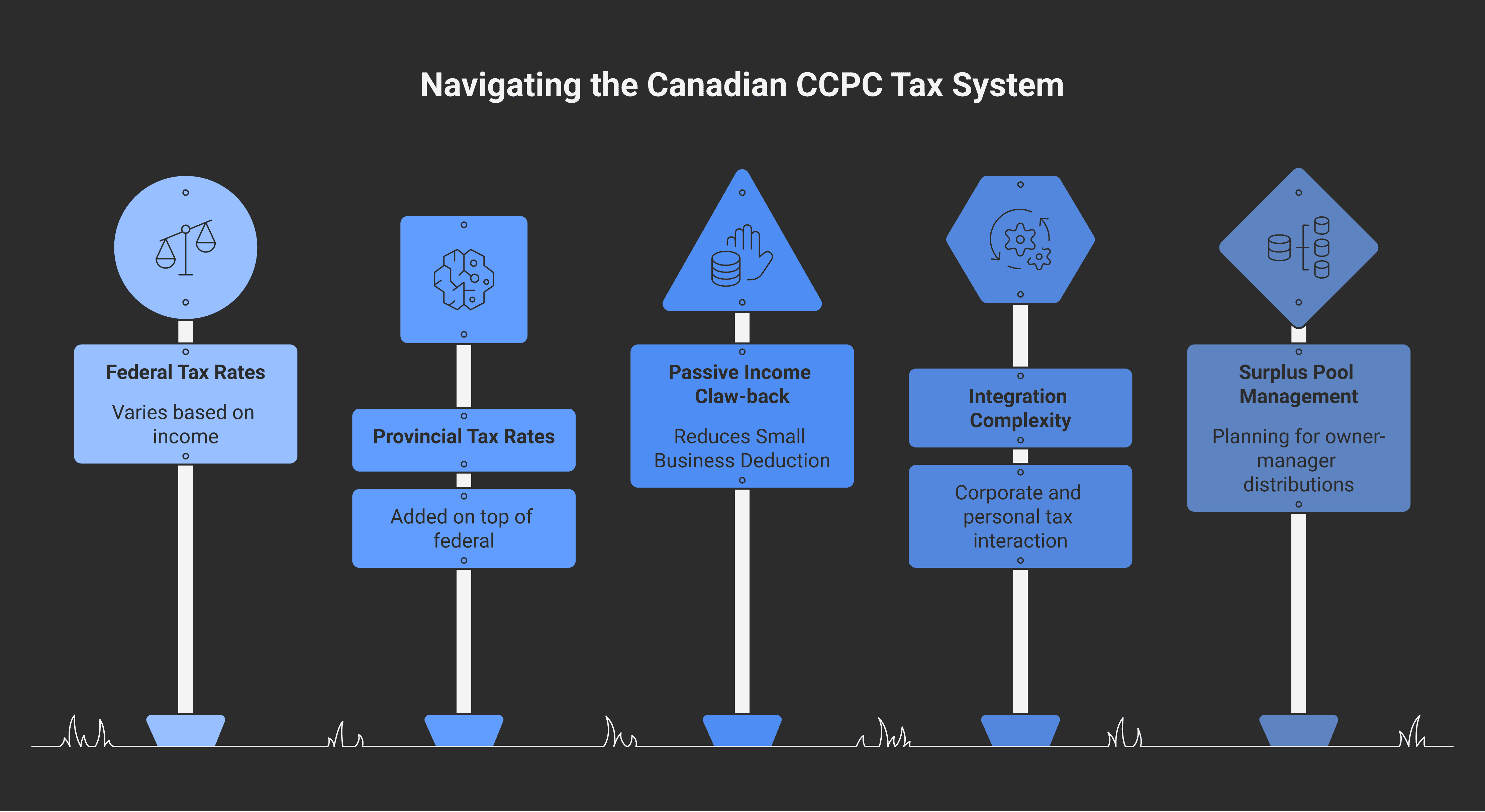
This is the pillar map of the system for owner-managers — the small-business deduction (SBD), the passive-income claw-back, integration, dividend pools (GRIP, LRIP, CDA, RDTOH), and the planning levers that follow from each. Detailed mechanics for each piece live in their own dedicated posts; this guide is the orientation.
Key takeaways
Canadian-controlled private corporations (CCPCs) pay federal corporate tax of 9% on the first $500,000 of active business income under sections 123 and 125 of the Income Tax Act (the small business deduction). Income above $500,000 (and all income for non-CCPCs) is taxed at the federal general rate of 15%.
Provincial rates layer on top. Combined small-business rates for 2026 range from 9% in Manitoba and Yukon to 12.2% in Ontario (dropping to 11.2% effective July 1, 2026 under Ontario's Budget 2026). The most common combined small-business rate is 11% (BC, Alberta).
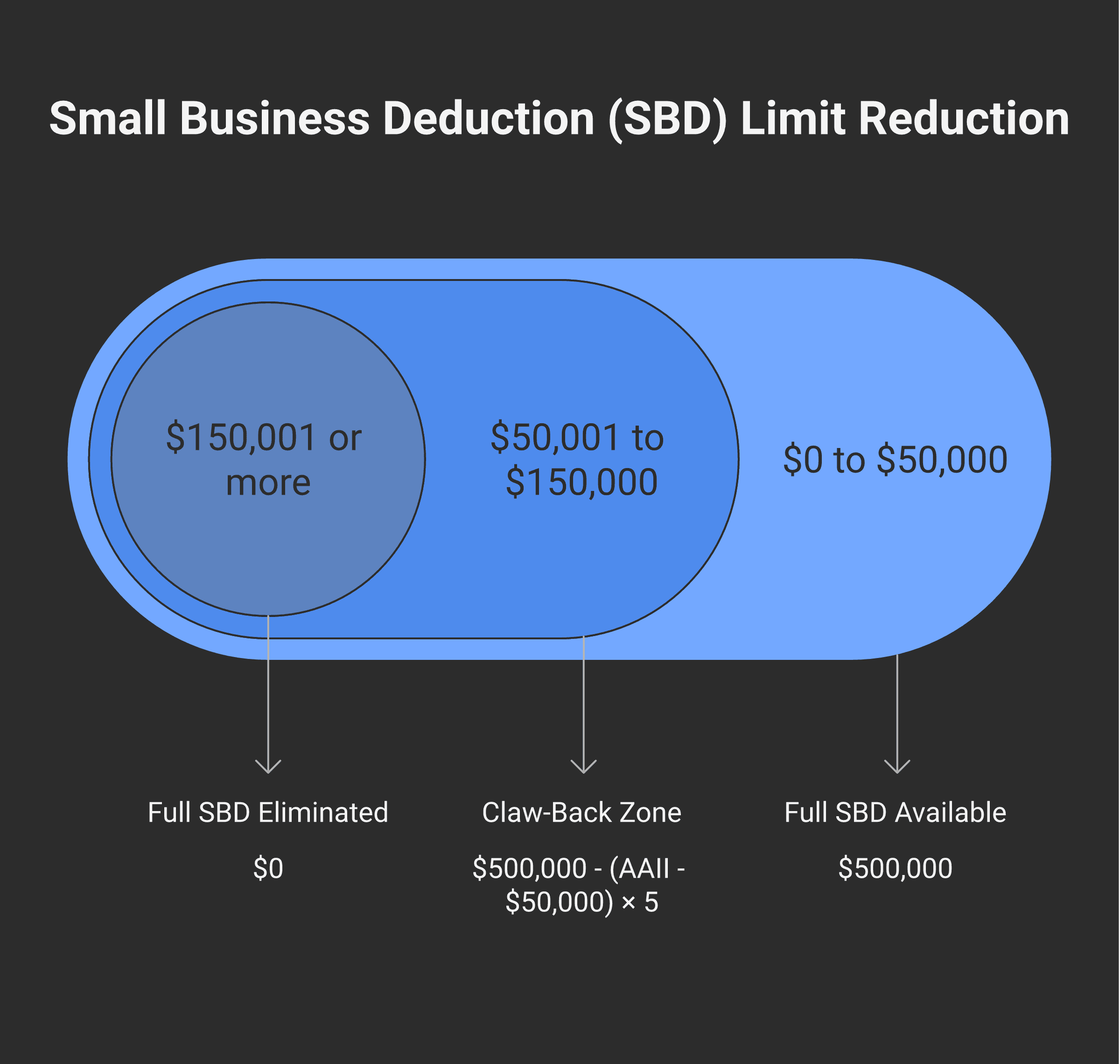
The SBD claws back when the corporation's "adjusted aggregate investment income" (AAII) exceeds $50,000 in the prior year, under subsection 125(5.1) of the Income Tax Act. For every $1 of AAII over $50,000, the $500,000 SBD limit is reduced by $5 — fully eliminated at $150,000 of AAII.
The corporate tax system uses integration under section 121: corporate tax plus personal tax on the resulting dividend should approximate the personal tax the owner would have paid if the income had been earned personally. The system works imperfectly — the actual differential is in the 0% to 5% range depending on province and income type.
Four key surplus pools drive owner-manager planning: GRIP (general-rate income pool — funds eligible-dividend designations), LRIP (low-rate income pool — non-eligible dividends), CDA (capital dividend account — tax-free dividends), and RDTOH (refundable dividend tax on hand — the corporate-side refundable tax that's recovered when dividends are paid).
What's a CCPC?
The Canadian-controlled private corporation (CCPC) is the corporate tax system's small-business carve-out. CCPC status under section 125(7) of the Income Tax Act requires:
The corporation is a private corporation (not publicly traded)
The corporation is a resident of Canada (incorporated under Canadian or provincial law)
The corporation is not controlled, directly or indirectly, by non-residents, by public corporations, or by a combination of non-residents and public corporations
Most small Canadian incorporated businesses are CCPCs by default. Loss of CCPC status — typically through a sale to a non-resident buyer or going public — eliminates access to the SBD and several other CCPC-only tax mechanics (the LCGE on QSBC shares, the deferred-stock-option treatment, refundable Part I tax through RDTOH).
The CCPC designation is fact-tested each tax year. A status change mid-year (e.g., a foreign investor becomes a majority owner in October) can shift CCPC status for the back half of the year — with timing rules that vary by mechanic.
The Small Business Deduction (SBD)
The SBD under section 125 of the Income Tax Act reduces the federal corporate tax rate from 15% to 9% on the first $500,000 of a CCPC's active business income each tax year. This is the structural reason incorporation is attractive for small-business owners: a CCPC earning $500K of active business income pays roughly half the federal corporate tax of a non-CCPC equivalent.
Active business income under section 248(1) is generally income earned from carrying on a business — operating revenue minus expenses. Excluded: investment income (interest, dividends, rental income, capital gains, royalties unless from an active business). Passive investment income inside a CCPC faces the 38.67% federal investment income rate (28% Part I + 10.67% Additional Refundable Tax).
The associated-corporations rule. Multiple CCPCs under common control share a single $500K SBD limit per year, under subsection 125(3). Two siblings who each own a 100%-owned CCPC are not "associated" by default — but if one owns more than 25% of the other's shares, or controls the other in fact or in law, they become associated and the limit is split.
Provincial SBD parallels. Every province offers a parallel provincial SBD with its own provincial small-business rate (typically 0% to 3.2% provincial). The combined federal-plus-provincial small-business rate is the rate most owner-managers reference. For 2026:
Province/Territory | Provincial small-biz rate | Combined small-biz rate |
|---|---|---|
Newfoundland and Labrador | 2.5% | 11.5% |
Prince Edward Island | 1% | 10% |
Nova Scotia | 1.5% | 10.5% |
New Brunswick | 2.5% | 11.5% |
Quebec | 3.2% | 12.2% |
Ontario | 3.2% (→ 2.2% from July 1, 2026) | 12.2% (→ 11.2%) |
Manitoba | 0% | 9% |
Saskatchewan | 1% | 10% |
Alberta | 2% | 11% |
British Columbia | 2% | 11% |
Yukon | 0% | 9% |
Northwest Territories | 2% | 11% |
Nunavut | 3% | 12% |
A CCPC operating in Manitoba or Saskatchewan pays 9% combined on its first $500K of active business income — the lowest CCPC small-business rate in Canada. An Ontario CCPC pays 12.2% (dropping to 11.2% mid-2026).
The passive-income claw-back
Introduced in Budget 2018 and effective for tax years starting after 2018, the passive-income claw-back under subsection 125(5.1) of the Income Tax Act reduces the $500,000 federal SBD limit based on the CCPC's adjusted aggregate investment income (AAII) in the prior year.
The mechanic:
AAII up to $50,000: No claw-back. Full SBD available.
AAII between $50,000 and $150,000: SBD limit reduced by $5 for every $1 of AAII over $50,000.
AAII over $150,000: SBD limit fully eliminated. All active business income taxed at the general rate.
Mathematically: SBD limit = $500,000 − [($AAII − $50,000) × 5], with a floor of $0.
AAII is broadly the corporation's investment income (interest, taxable capital gains net of losses, certain dividends, rental income that doesn't qualify as active business income), adjusted to exclude certain items. The intent of the rule was to discourage CCPCs from accumulating substantial passive investment portfolios — the original logic was that the SBD's preferential rate was meant for active operating businesses, not investment-holding structures.
Several provinces have decoupled from the federal claw-back: Ontario and New Brunswick maintain their provincial SBDs without the federal claw-back, meaning a CCPC with high AAII can lose the federal $500K SBD but retain access to the provincial SBD's lower provincial rate. The combined effect varies by province.
For owner-managers with substantial corporate investment portfolios, the claw-back is the dominant constraint on holdco vs operating-co structures. We cover the holdco investment income calculation in our holdco guide.
Integration — the system's design goal
Canadian corporate tax was designed around an integration principle: the total tax burden on a dollar of corporate income paid out as a dividend should equal roughly the personal tax on the same dollar earned directly. Integration uses the personal-side dividend gross-up and dividend tax credit under sections 82 and 121 of the Income Tax Act to refund the personal recipient for the corporate tax already paid.
The math:
Eligible dividends (paid from income taxed at the higher 15% federal general rate):
Corporate-level tax: ~26-31% combined federal + provincial
Personal-level tax (with gross-up + DTC): combined top rate ~37-46% on the dividend
Total combined corporate + personal: ~50-55%
Personal direct income at top rates: ~50-54%
Integration result: approximately neutral (small under- or over-integration in most provinces)
Non-eligible dividends (paid from SBD-rate income):
Corporate-level tax: 9-12.2% combined
Personal-level tax (with smaller gross-up + smaller DTC): ~42-48% on the dividend
Total combined corporate + personal: ~50-55%
Personal direct income at top rates: ~50-54%
Integration result: approximately neutral, but with deferral advantage while income sits in the corporation
The deferral advantage is the real benefit. Income earned and retained in a CCPC at 9-12% is dramatically lower than the same income earned personally at the top combined rate of 50%+. The corporation can invest the after-tax retained earnings inside the corporate structure (subject to AAII claw-back risk) before distribution.
For owner-manager pay decisions — salary versus dividend — the integration math is the starting point but rarely the deciding factor. CPP/EI benefits, RRSP room generation, supporting-person credit absorption, the spousal-credit interaction, and corporate-side deductibility considerations all interact with integration to produce a fact-specific best answer.
The four surplus pools
The four pools owner-managers track:
GRIP — General Rate Income Pool under subsection 89(1) of the Income Tax Act. Tracks income taxed at the higher general corporate rate (i.e., active business income above the SBD limit, and active business income of non-CCPCs). Dividends paid out of GRIP can be designated as eligible dividends on the recipient's T5 — qualifying the recipient for the more generous personal-side eligible-dividend gross-up and dividend tax credit. We cover GRIP mechanics in our eligible vs non-eligible dividends post.
LRIP — Low Rate Income Pool. Tracks income taxed at the lower SBD rate. Dividends paid out of LRIP are non-eligible dividends — the recipient gets the smaller gross-up and dividend tax credit, paying a higher personal rate. For most owner-manager CCPCs paying themselves from SBD-rate income, dividends are non-eligible.
CDA — Capital Dividend Account under subsection 89(1). The notional balance of tax-free distributable surplus, primarily from the 50% non-taxable portion of corporate capital gains. Capital dividends paid out of CDA under subsection 83(2) are received tax-free by Canadian shareholders. Election filed on Form T2054. See our CDA guide.
RDTOH — Refundable Dividend Tax on Hand. The corporate-level refundable tax on investment income. When the CCPC earns passive investment income, part of the corporate tax paid is refundable — the refund triggers when the corporation pays dividends to its shareholders. Split since 2019 into eligible and non-eligible RDTOH pools depending on which dividend types unlock which refund. We cover RDTOH mechanics in our forthcoming RDTOH deep-dive post.
The four pools interact: a CCPC paying eligible dividends to a shareholder draws from GRIP, refunds eligible RDTOH; the same CCPC paying a capital dividend draws from CDA; non-eligible dividends draw from LRIP and refund non-eligible RDTOH. The timing of distributions can change which pool is drawn from and which refund is triggered.
Owner-manager pay structure
A CCPC owner has multiple ways to extract value from their corporation. The main choices:
Salary. The corporation deducts the salary against active business income, T4s are issued, CPP and EI are payable (employer + employee portions). Salary creates RRSP contribution room for the recipient (18% of earned income up to the annual cap). Highest combined corporate-plus-personal tax efficiency in most middle-income scenarios.
Non-eligible dividend. No corporate-side deduction (dividends are not deductible). No CPP/EI. No RRSP room generated. Personal-side dividend gross-up + DTC apply. Typically most efficient for top-bracket owners taking large income, or for CCPCs that don't want to incur the CPP/EI cost.
Eligible dividend. Requires sufficient GRIP balance (income taxed at general rate). Smaller personal-side tax than non-eligible dividend at most income levels. Useful when the CCPC has GRIP available — typically because some income was taxed at the higher general rate.
Capital dividend. Tax-free distribution from CDA. Best vehicle for one-time payouts when CDA balance allows.
Owner-manager bonus — a year-end mechanism to deduct salary income against any remaining active business income above the SBD limit. The corporation deducts the bonus; the owner receives the bonus as income.
For most CCPCs in the SBD bracket ($500K active income), the structural optimal owner-manager pay mix is something like 60-80% non-eligible dividend / 20-40% salary, but the right answer depends on the owner's personal bracket, family situation (any income-splitting opportunities), and corporate-side considerations (need to generate RRSP room, etc.).
We cover the salary vs dividend decision in detail — including the 2026 14% rate change implications, the CPP enhancement increase, and the cumulative effect on RRSP room generation.
Year-end planning checklist
A typical CCPC year-end checklist for an owner-manager:
Confirm CCPC status has been maintained throughout the year (no foreign-control change)
Calculate SBD allocation — including associated-corporation sharing if multiple corporations exist
Project AAII for the year — assess passive-income claw-back impact on next year's SBD limit
Run owner-manager pay analysis — salary vs dividend mix, factoring in current-year personal bracket and corporate retained-earnings position
Confirm GRIP and LRIP balances before declaring eligible vs non-eligible dividends
Review CDA balance for opportunistic capital dividend declarations
Verify RDTOH balance — declare sufficient dividends to recover any refundable tax that would otherwise sit on the books
Plan upcoming year's compensation timing — bonus declarations, salary changes, dividend cadence
For Modern Axis client engagements on CCPC owner-managers, this year-end review is the core annual deliverable. The combination of integration math + AAII claw-back projection + pool balance management is where the planning value sits — well beyond the corporate return preparation itself.
Frequently asked questions
What is the corporate tax rate in Canada for 2026?
For CCPCs (Canadian-controlled private corporations), the federal small business deduction reduces the corporate tax rate to 9% on the first $500,000 of active business income under section 125 of the Income Tax Act. Income above the SBD limit (and all income for non-CCPCs) is taxed at the federal general rate of 15%. Provincial rates layer on top — combined small-business rates range from 9% (Manitoba, Yukon) to 12.2% (Ontario, Quebec), with most provinces around 10-11%.
What is the small business deduction (SBD) and who qualifies?
The SBD under section 125 of the Income Tax Act reduces the federal corporate tax rate to 9% on the first $500,000 of active business income for CCPCs. To qualify, the corporation must be Canadian-controlled, private, and resident in Canada. The SBD is shared between associated corporations, so multiple CCPCs under common control allocate the $500,000 between them.
What is the passive income clawback for CCPCs?
Under subsection 125(5.1) of the Income Tax Act, the $500,000 federal SBD limit is reduced when the CCPC's adjusted aggregate investment income (AAII) in the prior year exceeds $50,000. For every $1 of AAII over $50,000, the SBD limit is reduced by $5 — fully eliminating the SBD when AAII reaches $150,000. AAII includes most passive investment income (interest, dividends, capital gains, certain rental income).
What is the integration principle in Canadian corporate tax?
Integration is the design goal that the total tax burden on corporate income paid out as a dividend should approximately equal the personal tax on the same income earned directly. The personal-side dividend gross-up and dividend tax credit (sections 82 and 121 of the Income Tax Act) refund the personal recipient for the corporate tax already paid. The system works imperfectly — depending on province and income type, the integration result is typically within ±5% of the personal direct-income tax. The deferral advantage (keeping income in the corporation at lower rates) is often more valuable than the integration result itself.
What are GRIP, LRIP, CDA, and RDTOH?
These are the four key surplus pools tracked by a CCPC: GRIP (General Rate Income Pool — funds eligible dividend designations from income taxed at the general rate), LRIP (Low Rate Income Pool — non-eligible dividends from SBD-rate income), CDA (Capital Dividend Account — tax-free dividends from the 50% non-taxable portion of capital gains), and RDTOH (Refundable Dividend Tax on Hand — corporate-level refundable tax on investment income, refunded when dividends are paid). Owner-manager planning revolves around managing these pool balances.
Should I take salary or dividends from my CCPC?
The right mix depends on your personal marginal rate, family situation, RRSP room generation needs, and corporate-side considerations. Salary is deductible to the corporation, generates RRSP room, and incurs CPP/EI. Non-eligible dividends are not deductible and don't generate RRSP room but avoid CPP/EI. Integration math suggests the two are roughly equivalent at top marginal rates, but the deferral advantage of retaining income in the corporation at the SBD rate (9-12% combined) is meaningful before distribution. For most CCPCs in the SBD bracket, a 60-80% non-eligible dividend / 20-40% salary mix is typical, but the right answer is fact-specific.
What happens if my CCPC loses CCPC status?
Loss of CCPC status (typically through a sale to a non-resident buyer or going public) eliminates several mechanics: the small business deduction, the LCGE on QSBC shares for selling shareholders, the deferred-stock-option treatment, and refundable Part I tax through RDTOH. The status change is fact-tested year-by-year and can trigger mid-year complications (e.g., a foreign investor acquiring a majority position in October splits the year for some purposes). Loss of CCPC status is usually a planned event — most owner-managers do not want to lose it inadvertently.
This article is for general information only and does not constitute professional tax, accounting, or legal advice. Every tax situation is different, and a blog post — no matter how detailed — cannot account for the specific facts that may change the analysis for you. Before acting on anything you've read here, speak with a qualified tax professional about your own circumstances.
Alex Ataman, CPA
Founder
Modern Axis CPA